Research & Planning
In Year 12 our task was to create an opening sequence for a British Social Realism Film. This was a genre of film I did not regularly watch so doing research for this was vital. For some research into what the conventions of British Social Realism Film are we found YouTube clips of British Social Realism films and looked at the technical aspects of it and found some conventions within the genre for it. To understand what the exam board required of us we looked at past students work and evaluated it looking at the positives, the negatives and how we could improve on it. The institution we were creating the film for was film 4 and so we had to research them heavily to find what kind of films they generally produce so we looked at their ethos and history and examples of their films.

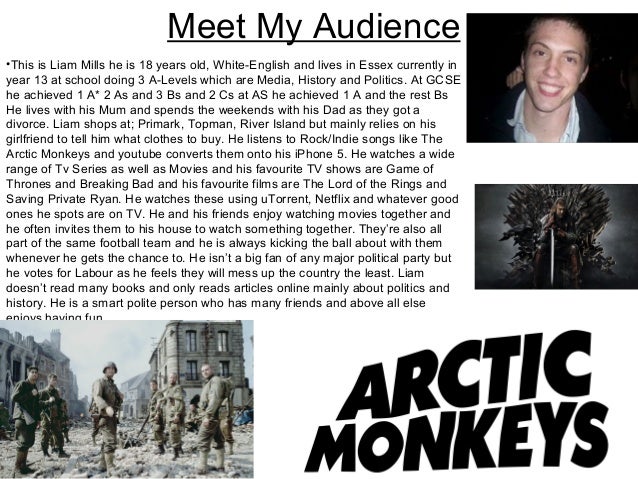
We also needed to know who our target audience was so we created vox pops and asked them various questions. Some of the questions we asked were if they were watched BSR films and whether or not they thought our idea was good. We also created a theoretical audience for our film in a PowerPoint slide and said what kind of films our audience watch and what they do in their free time.


We also had to do a lot of planning to make sure the production process went smoothly and during this we made; call sheets, location recces, cast list and location lists. All these things helped us during the production phase as it gave us a clear guide.
From this I became much better at understanding what my audience is like through research as we can see from my original 'Meet the Audience' blog to the more recent one which included much more detail.
Another example of how I improved my research and planning skills is my planning for when, where and what I will film during production. An example of this is my shooting scripts for my BSR film and the Music Video Mashup
If we compare these two shooting scripts we can see that the first one which is the one for the mash-up has much more detail. As well as that during production we actually followed it better meaning it was less of a disaster and made the editing process much easier on us as we didn't have to salvage a mess.

We also needed to know who our target audience was so we created vox pops and asked them various questions. Some of the questions we asked were if they were watched BSR films and whether or not they thought our idea was good. We also created a theoretical audience for our film in a PowerPoint slide and said what kind of films our audience watch and what they do in their free time.

We also had to do a lot of planning to make sure the production process went smoothly and during this we made; call sheets, location recces, cast list and location lists. All these things helped us during the production phase as it gave us a clear guide.
From this I became much better at understanding what my audience is like through research as we can see from my original 'Meet the Audience' blog to the more recent one which included much more detail.
Another example of how I improved my research and planning skills is my planning for when, where and what I will film during production. An example of this is my shooting scripts for my BSR film and the Music Video Mashup
If we compare these two shooting scripts we can see that the first one which is the one for the mash-up has much more detail. As well as that during production we actually followed it better meaning it was less of a disaster and made the editing process much easier on us as we didn't have to salvage a mess.
Conventions
Camera and Editing
 To make a BSR film you have to use the conventions of BSR. Using the research I found out the conventions of all the technical aspects of BSR films. Here is an example of a blog post looking at camera and editing in a BSR film and what about it is conventional in a BSR film. Some conventions of camera typically was that there was an establishing shot in the opening sequence for most of the films. We also noticed that the editing in these films is generally very basic and consist of mainly cuts to add to the sense of realism created. One way I improved was that I learned how to use continuity editing better as when we compare my opening sequence with my continuity editing exercise it was a much better piece. My editing in general improved to as it looked smoother and more refined than previous pieces of work.
Themes and Narrative

The theme of our film was racism and from researching we found that this was a very common theme in BSR and we saw that BSR films normally have a negative theme like poverty or abuse so our was keeping with these which was good. This is England is a film which has some similar elements to ours as we both had scenes of racism where a man betas another man due to his race and we see the corruption of youth too as Shaun in This is England witnesses the abuse so does Joe in our film. For narrative we looked at Mckee's theory and tried to follow it as best we could. McKee's narrative involves an; exposition, agents of change, conflict, elaboration and a climax. I felt I improved with narrative over the year as my BSR opening told a much clearer story than my continuity editing exercise.
Mise-en-scene

Mise-en-scene is a big part in all films an encompasses very key elements including; location, actors, costume, era and props. When we were planning our BSR production we kept all these things in mind and wanted all these things to match what they would be in a BSR films. This is why in our shooting script we paid such detail into the mise-en-scene so detailing who our actors were where we were filming and what equipment we needed as props. We saw that in BSR films most of the character live in poverty or run down areas, this is why in our film we used mise en scene to match this. For example in my opening sequence we set the largest scene the fight scene in a run down alleyway and had the characters wearing very cheap clothing.

Sound
In order to keep the idea of realism many BSR films have only diegetic sounds meaning what we hear is what the characters are hearing with the odd exception for a voice over or soundtrack. We kept the same style in our film and keep most of the sound diegetic mainly being dialogue.
Creativity
The definition for creativity given by Csikszentmihalyi was "creativity occurs when a person, using the symbols of a given domain has a new idea or sees a new pattern, and when this novelty is selected by the appropriate field for inclusion into the relevant domain. This means that when someone comes up for a new idea for something within the restriction of a genre and the conventions within it and is approved by the teacher and deemed worthy by the exam board then it is creative. I showed this when I came up for my idea about a BSR film as it stuck to the conventions and was a new idea which was approved by my teachers. When we compare this task to the continuity editing exercise I showed a lot more creativity with the story and the the editing techniques I used as in the continuity editing exercise I just used simple cuts that told a story in chronological order but for the BSR opening I used the idea of parallel editing which added another level of depth to the piece.
Post Production
Video
I think the biggest improvement of mine over the year has been my editing. I learned many new techniques such as; match on action, continuity editing, parallel editing , fades, dissolves and many more. These techniques allowed me to improve upon my work and saw a drastic change in the quality of my continuity editing exercise to my BSR opening. For example in the editing exercise the clips jump around and there is very little continuity but in the opening there was much more continuity and it flowed much better.
Sounds
Most BSR films consist of mainly diegetic sound meaning what we hear is what the characters hear with the exception of some voice overs or music. In my film most of the sound was through the dialogue exchanged by the characters. I used the dialogue recorded by the camera which made my job easier but the quality of the sound was not as high as it could have been if I used a mic. Sometimes when a character was speaking when off-screen I had to separate the sound from the video and place it over the clip I wanted it to play under.
Graphics
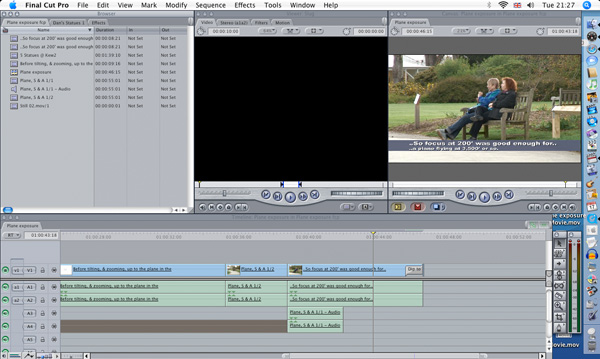
For graphics I learned that the graphics in BSR films are played over the video which differs from other types of films where the graphics are shown on the screen by themselves. In order to do this we imported the clips and the graphics into final cut and placed the graphics on a higher layer than the video of the film. This helped me imitate a BSR film opening even more as I followed one of the conventions.
Digital Technology
I think the biggest improvement of mine over the year has been my editing. I learned many new techniques such as; match on action, continuity editing, parallel editing , fades, dissolves and many more. These techniques allowed me to improve upon my work and saw a drastic change in the quality of my continuity editing exercise to my BSR opening. For example in the editing exercise the clips jump around and there is very little continuity but in the opening there was much more continuity and it flowed much better.
Sounds
Most BSR films consist of mainly diegetic sound meaning what we hear is what the characters hear with the exception of some voice overs or music. In my film most of the sound was through the dialogue exchanged by the characters. I used the dialogue recorded by the camera which made my job easier but the quality of the sound was not as high as it could have been if I used a mic. Sometimes when a character was speaking when off-screen I had to separate the sound from the video and place it over the clip I wanted it to play under.
Graphics
For graphics I learned that the graphics in BSR films are played over the video which differs from other types of films where the graphics are shown on the screen by themselves. In order to do this we imported the clips and the graphics into final cut and placed the graphics on a higher layer than the video of the film. This helped me imitate a BSR film opening even more as I followed one of the conventions.
Digital Technology
Hardware (Digital Equipment)
For the course the digital equipment we used were the Cameras and the Macs. I have developed my understanding how different camera angle and shots can convey different meanings. For example in this shot in my opening I used a low angle of the bully to connote his authority over the other character.


Software Digital Programs
When making my BSR piece I became proficient with iMovie an editing software, something within iMovie that I never did before was adding in external audio into the movie and editing it. I did this with the music for the film and also recorded basic background noise that I put into the film. As well as iMovie I used final cut to add in the graphics. Final cut is something I have never used before so everything was new to me but I learned how to add in images and place them into the timeline.

Online (Web Base Technologies)
At the beginning of the year when I made blog posts t on blogger and not use any other form of digital technology. As the year went on however I began using other technologies such as E-maze in my evaluation.

No comments:
Post a Comment